Introduction — Advantage of Clean Environment: why your space matters to your mind
The advantage of clean environment extends beyond appearance to measurable mental gains. A tidy, low-allergen home reduces visual chaos and interior contamination that contribute to daily stress, sleep disruption and cognitive load. This guide explains five psychological benefits backed by research and practical cleaning steps.
We summarise evidence from decluttering and biophilic design studies, indoor air and allergen reviews, and hospitality research that links cleanliness to guest satisfaction (see Extension 2022; Yale 2024).
Who benefits: busy professionals, parents managing family health, and holiday-let hosts seeking higher reviews. Practical next steps include an initial deep clean to reset baseline, followed by a regular maintenance cadence tailored to lifestyle.
Featured image illustrates a calm, sunlit living area with plants and cleared surfaces to cue biophilic benefits and visible order. The article maps scientific findings to Britshine’s eco-friendly, hospitality-grade services for homeowners and hosts in York, showing how targeted cleaning choices support mental wellbeing and operational outcomes.
Actionable steps follow below now. Check evidence links in-text below.
TL;DR — Key advantages of a clean environment at a glance
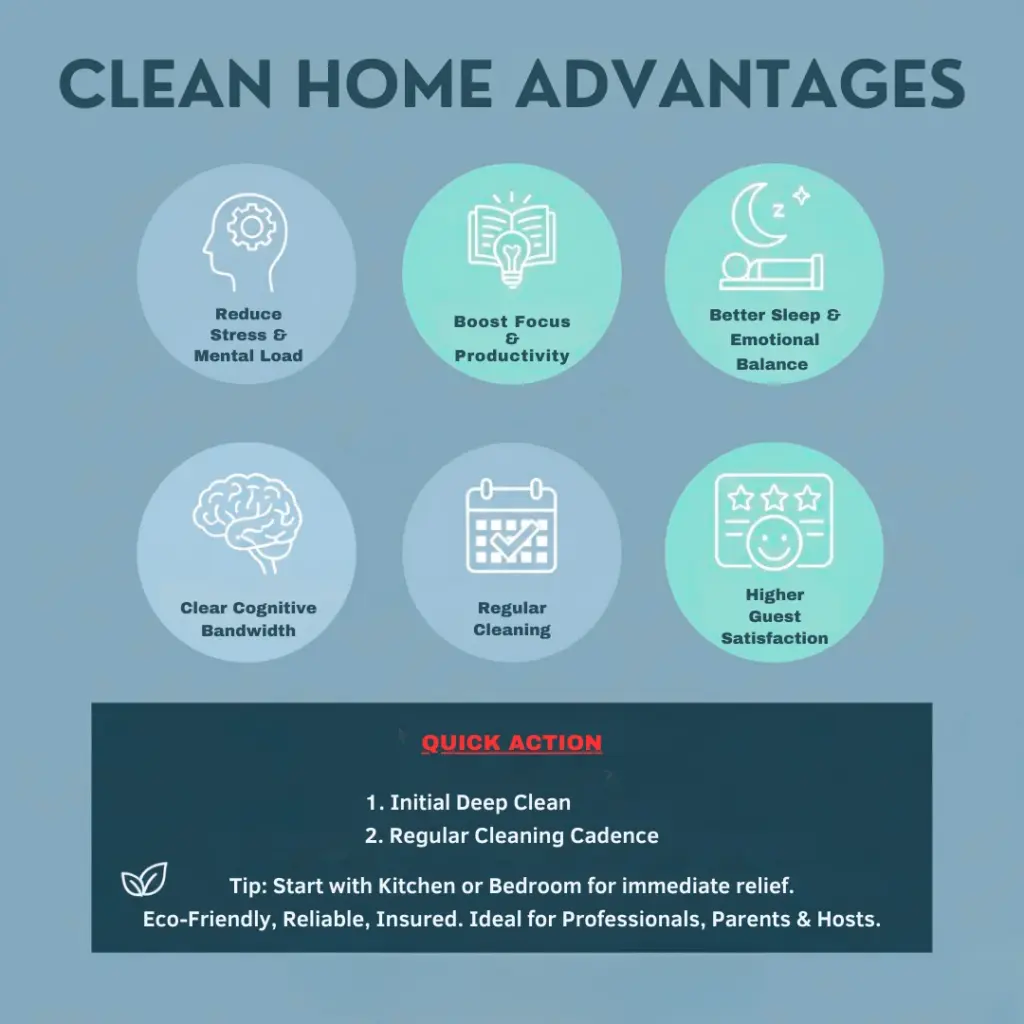
- A consistently clean home reduces stress and mental load, improving wellbeing.
- Tidy spaces boost focus and clean space productivity for remote work or study.
- Cleaner bedrooms support better sleep and emotional regulation.
- Decluttering clears cognitive bandwidth and improves decision-making.
- For hosts, professional cleaning raises guest satisfaction and review scores.
- Quick action: book an Initial Deep Clean, then set a Regular Cleaning cadence to sustain gains.
Tip: start with one high-impact task — kitchen or bedroom — and notice immediate relief. Britshine’s eco-friendly services map to these outcomes for busy professionals, parents, and hosts who need reliable, insured cleans. Consider an Initial Deep Clean after renovations or seasonal pollen peaks to reset allergen baselines. Schedule online for quick availability and receipts, today, easily.
How a clean environment reduces stress and anxiety
Why visible mess compounds stress
Visible mess functions as a continuous, low-level stressor by maintaining an active to-do list in the mind. Visual disorder prompts attention shifts and increases perceived task load, elevating cognitive effort and stress hormones. Studies link home disorder to higher physiological stress and lower mood. (UCLA 2010)
Small cleaning wins that reduce cortisol-like responses
Physical irritants such as dust, pet dander and mould trigger respiratory discomfort that raises arousal and can worsen anxiety in sensitive people. Regular dusting, HEPA-filter vacuuming and targeted allergen removal measurably reduce symptom burden in intervention trials and improve daily comfort. (PMC 2020)
Perceived control over the immediate environment reinforces predictability and lowers baseline stress. Creating simple routines—mail sorting, dish resets, and a nightly surface clear—turns maintenance into automatic behaviour that reduces decision friction.
Small cleaning wins
- Clear one horizontal surface for ten minutes each day to see immediate relief and visual order.
- Sort incoming mail immediately—recycle, file, action—so paper piles do not accumulate.
- Schedule a weekly 20-minute ‘kitchen reset’ after dinner to remove dirty dishes and wipe counters.
- Use a checklist or timer to convert tasks into habits; reward completion to reinforce routine.
Spotting stressors: common triggers include mail piles, unwashed dishes, sticky surfaces and overflowing laundry; addressing the smallest of these first reduces perceived burden quickly. Aim first for consistency rather than perfection when maintaining reduced stress. Small wins compound fast indeed.
Clean spaces boost focus, productivity and cognitive function
Clutter increases involuntary attention shifts that interrupt concentration and fragment task focus. Tidy environments reduce background distraction, enabling longer uninterrupted work periods and improved output quality. Neuroimaging and cognitive studies show visual clutter alters information flow and degrades sustained attention. (Yale 2024)
Decluttering frees working memory previously used to manage visible disorder, supporting planning, problem-solving and multi-step tasks. Students and remote workers report faster task completion when visual noise is minimised and tools are organised in a consistent layout. (PMC study)
Offices with scheduled cleaning and surface disinfection observe fewer sick days and better employee perceptions of workplace wellbeing. Regular disinfection programs and quick turnaround cleaning for shared spaces reduce contamination spread and support attendance, which can map to productivity gains. (Healthy Workplace 2015)
Design a focus zone
- Choose one surface for focused work; keep it clutter-free and dedicated to tasks.
- Remove non-essential items; allow only tools needed for your current task.
- Set a 25–50 minute timer (Pomodoro) and clear the desk during breaks to maintain order.
- Use cable management, small storage and a single device docking point to reduce decision friction.
- Make the focus zone visible and portable where possible; a clear visual boundary signals the brain that work time has begun. Combine with consistent lighting and background noise control to sustain concentration. Reassess monthly and adapt to changing tasks for better performance.
How cleanliness improves sleep and emotional regulation
Nightly tidying rituals that cue relaxation
Clean bedrooms reduce allergens and sensory disturbances that interfere with sleep continuity. Better respiratory comfort decreases nocturnal awakenings and supports deeper slow-wave sleep, which underpins daytime emotional regulation. Intervention studies report improved symptoms following home-based allergen reduction and air quality improvements. (PMC study)
Establishing a short pre-bed ritual—two to ten minutes—signals wind-down behaviour to the brain. Simple acts such as clearing bedside clutter, setting out tomorrow’s essentials, and switching off bright overhead lights cue a transition from active planning to rest. These behavioural cues often accompany measurable improvements in sleep onset latency and perceived sleep quality. Try the routine nightly for at least two weeks.

Textiles and allergens: what to clean regularly
Textiles trap allergens and odours; regular linen, mattress and upholstery care reduces sources of nighttime irritation. Use wash cycles at the manufacturer-recommended temperature, steam clean mattresses annually, and vacuum upholstery with HEPA filtration. For food-related odours, follow COSHH-aligned food-grade cleaning in refrigerators to preserve safety. Replace pillows every two years.
Refer to cited intervention trials and systematic reviews that link allergen and air-quality improvements with better sleep and improved emotional regulation across ages today.
Decluttering and mental clarity: the neuroscience
How the brain responds to visual disorder
Clutter increases background neural noise, making sensory filtering less efficient and raising cognitive load. Neuroscience research shows that excess visual stimuli alter network dynamics and reduce the brain’s ability to prioritise relevant information, which impairs attention and working memory during complex tasks. (Yale 2024)
Decision fatigue arises when trivial choices pile up—what to wear, which mail to process, which cup to wash—consuming limited cognitive resources. Decluttering removes many low-value decisions and preserves executive control for meaningful work. Hosts and parents report lower daily friction when visible choices are minimised. This conserves energy for creativity.
Sustained organisation lowers activation energy for healthy routines such as exercise, meal preparation and reading. Habit formation follows from repeated small wins and predictable cues, locking in behaviour that supports cognition and wellbeing. Over months, organisation reduces time wasted searching and increases perceived life control and reduces chronic stress levels.
Practical method
- Time-box 15 minutes daily; sort into keep, donate, recycle, discard piles.
- Pair decluttering with a short reward to reinforce repetition and habit formation.
- Review monthly and remove items unused for sixty days to prevent re-accumulation.
Social & relational benefits — confidence, hospitality and guest readiness
Why guests equate cleanliness with care
Tidy, fresh spaces reduce host anxiety and allow more present social interactions. When hosts feel confident about cleanliness they focus on hospitality rather than logistic worries, which improves conversation quality and guest comfort.
Why cleanliness drives guest perception
Cleanliness ranks among the top factors in holiday-let and short-term rental reviews; guests often equate pristine kitchens and bathrooms with overall care. Analytical studies of guest reviews find cleanliness strongly correlates with higher ratings and repeat bookings. (Cornell study) Hosts that use professional turnovers report faster check-ins and fewer guest complaints about cleanliness.

Reducing host anxiety with professional turnovers
Shared homes benefit from clear chore expectations or outsourcing. Regular Cleaning reduces arguments over chores, offers fairness, and preserves relationships by removing a recurring source of domestic tension and stress.
Britshine’s Airbnb Cleaning provides swift turnovers, linen refresh and sanitization to protect guest health and speed listings. Holiday-let packages include restocking and staging that improve presentation. These services reduce host workload, support higher review scores and faster turnovers, and include insured, DBS-checked specialists for peace of mind.
Practical, low-effort cleaning tips that protect mental wellbeing
Two-tier cleaning plan: Deep Clean + Maintenance
A two-tier approach resets baseline cleanliness quickly and preserves mental gains with minimal upkeep. Start with an Initial Deep Clean to remove accumulated grime and allergens, then maintain with Regular Cleaning or short micro-routines to prevent re-accumulation and sustain wellbeing.
Initial Deep Clean: comprehensive attention to kitchens, bathrooms, upholstery and appliances; ideal after renovations, long vacancies or seasonal pollen peaks. Maintenance: weekly or bi-weekly Regular Cleaning focuses on high-traffic surfaces, vacuuming with HEPA filters and targeted disinfecting of touchpoints to keep allergen and microbial loads low and protect families’ health.
Micro-routines (10 to 20 minutes)
- Morning: make the bed, wipe surfaces, put away clothes.
- After meals: clear dishes, wipe counters, quick floor sweep.
- Evening: 10-minute kitchen reset and set out next-day essentials.
- Weekly: 60–120 minute zone clean—bathroom, kitchen, bedrooms, or living area.
- Use timers and checklists to convert tasks into habits and reduce friction.
- Outsource oven, fridge and upholstery deep cleans seasonally to specialists for best results. Book online instantly.
Eco-friendly choices and product effectiveness
Choose non-toxic, biodegradable formulations and apply products matched to the task—surfactants for grease, enzymatics for organic residues. Evidence shows green cleaning options can be effective when used correctly; select professional-grade, certified products where possible. Britshine documents and keeps product records publicly.
When to call a professional: ovens, post-renovation cleans, and allergen-heavy tasks
Delegate high-effort tasks: ovens, upholstery, and post-renovation cleans. Britshine’s Initial Deep Clean, Oven/Fridge Deep Clean and Instant Online Booking streamline delegating. Insured, DBS-checked specialists reduce health risk and provide a satisfaction guarantee with a free re-clean if needed and receipts.
FAQ — common questions about the advantage of clean environment and mental health
Many report relief after clearing visible clutter; reductions in stress often follow within days. Deeper sleep and allergen gains require an initial deep clean plus weeks’ maintenance. (Extension 2022)
Yes when matched to the task and used correctly. Systematic reviews and guidance find certified green formulations can achieve comparable cleaning results while lowering chemical exposure; choose products with verified certifications and professional application. (PMC review)
Professional cleaning works as a partnership: outsource high-effort tasks while keeping daily habits. It preserves agency, reclaims time and lowers stress. Use cleaners to complement—not replace—small routines like a kitchen reset.
Start with an Initial Deep Clean to reset surfaces, then maintain weekly or bi-weekly. High-turnover listings need turnovers after each stay. Add seasonal deep cleans for pollen or post-renovation resets regularly.
Use Airbnb Cleaning for fast turnovers, linen changes and sanitisation. Schedule an Initial Deep Clean when launching or after vacancies. Pair services with a hospitality checklist to secure consistent five-star presentation.